
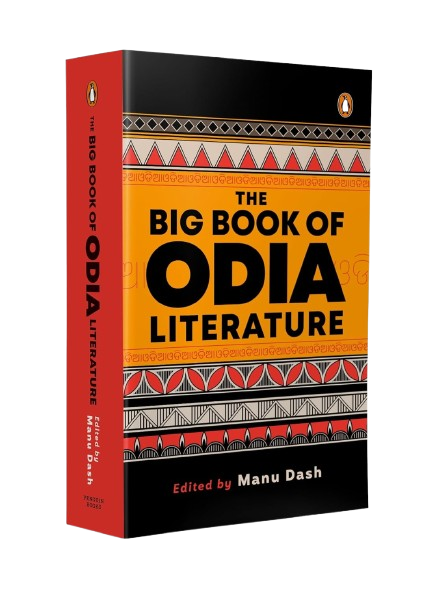
The Big Book of Odia Literature
With a literary history spanning centuries, the languages of Odisha have found myriad expression in prose, poetry, mythology, history, and politics.
The Big Book of Odia Literature goes where very few have dared―into a history of language, literature and song that can be traced back all the way to the tenth century.
In this careful curation, The Big Book curates essays, stories, poems, and plays that have defined the culture of a state and a people. A first of its kind, the volume is for lovers of linguistic history and literary traditions.
“Offering a kaleidoscope of writing from the 15th century to the present, this book is a wonderful window into the concerns, thought, culture and philosophy that details Odia literary writing. The book is divided into many sections: Poetry, which is again sub divided into poems from different languages of the region including Santali, Sanskrit and Odia of course, and Plays, Short Stories, and Essays.
Of course the book features a plethora of writers and the translators who have made their work accessible for us in English. As Editor, Dash has been clever in his selection, picking writings of different flavours, and subjects that engage people at different levels. One imagines a lot of vernacular literature to stem from angst that cannot be articulated except in writing. But here is a platter of delights that range from the sombre to the funny, from the descriptive and poetic to sharply satirical.”
– The New Indian Express (Sathya Saran)
“One of the notable aspects of this anthology is editor Manu Dash’s effort to preserve the linguistic diversity of Odisha. The collection includes poetry in several tribal languages, such as Santali, Kui, Oraon, Mundari, and Kharia. Many of these poems, passed down orally through generations, are by unknown poets. Dash’s selection offers a glimpse into the cultural and philosophical richness of these works. Although the poets are often anonymous, their works convey meaningful and insightful ideas, providing a significant connection to Odisha’s diverse literary traditions.”
– Scroll.in (Abdullah Khan)
“Once, a well-known linguist and scholar, Dr Suniti Kumar Chatterjee had while comparing Odia literature with Sanskrit literature has opined that Upendra Bhanja, a great medieval poet, has raised the level of Odia language high at par with the mother language, Sanskrit.
But, in spite of having a rich language and ancient literature of 1500 years old, our presence before India or foreign readers were miniscule in comparison to Bangla literature. This book is the first attempt, a tip of the iceberg of Odia literature, in almost 90 years, from the inception as a separate State. It’s (Odia literature) a mine of gold; the more you dig into it, the more it gives you surprises.”
– The Asian Review (Manu Dash speaks in an interview with Rohana Kaluarachchi)
“India is still way behind in translating regional artists because India is rapidly losing its multicultural and multilingual traits, thanks to modern education and overemphasis on certain languages both national and international. It’s a fact that regional artists are never given the kind of platform they deserve. When learning in a particular state, national or international language is encouraged tribal languages and dialects tragically lose their charm.
The other aspect of the problem is picking up these regional artists and their practices. We are so full of them (almost seven hundred languages and as many traditions) that only a few regional literary practices and languages are picked up for translation.
Only the ones capable of catering to popular cultures are picked up for translation. If we are to preserve these literatures, then a conscious and conscientious effort towards these is essential.”
– Uswa Literary Review (Manu Dash speaks in an interview with Kabir Deb)
“In the mid-20th century Odisha, an anti-establishment movement emerged as a response to the socio-political tensions before and during the 1975 Emergency. It was named the Anam (Odia for “Nameless”) Movement. True to its name, despite having had an impact on Odisha’s literary and cultural spheres significant enough to pit them as potent weapons against the regime, it is not too widely known today. Odia poet Manu Dash, a leading figure of the Anam group of poets and writers, has since been an active participant in shaping the literature of the state. From organising various literary festivals to producing the Anam poetry journal and other curated volumes, he emphasises reading as a cultural practice. Dash’s The Big Book of Odia Literature, published by Penguin India, also forms a part of his continuing endeavour.”
–Deccan Chronicle (Ankit Rath)
“Manu Dash is a bilingual poet and writer who has been actively involved in the Anam movement. His years of work with Odia literature through writing, literary activism and literary journalism give him a vantage point from which to look at the vast body of literature from Odisha and bring to readers those representative works that help us trace the state’s literary legacy. In his Editor’s Note to this compilation, he provides a clear perspective on the journey of each genre as well as an overview of literature from Odisha in general.”
– The Bangalore Review (Sucharita Dutta-Asane)
“Eclectic and inclusive, this important anthology brings together stories, poems, essays, and plays by Odia writers, showcasing the rich linguistic heritage and cultural history of the Odia people. It celebrates a wide array of literary works that mirrors the region’s deep-rooted traditions aesthetic and sensibilities — ranging from classical antiquity to the contemporary era — cataloguing shifts, movements, and landmark upheavals that have shaped the collective psyche of a people from the eastern coast of India. This is a land known for its life-corroding cyclones, droughts, and poverty, and its people have long been stereotyped as somewhat low-key and indifferent to their own cultural wealth.”
–The Federal (Durga Prasad Panda)
“The Big Book of Odia Literature is a groundbreaking work that provides readers with a comprehensive introduction to the rich and varied literary traditions of Odisha. For both scholars and general readers, it offers an accessible and illuminating journey into the heart of one of India’s most ancient languages and cultures with a very rich history.”
– Outlook (Kamalakar Bhat)
“Some books, like some people are like the roadside tea shop, where on a night of winter in another lifetime, your bike had got a puncture. You carry the night and the tea shop within, without ever being able to situate them in the atlas of any possible expression. Their memory comes on its own and vanishes on its own. Though never fully grasped like the primordial sorrow of the final blackout, the night and tea shop lie brooding in the region between longing and loss. Maybe happiness is something like this, and so is THE BIG BOOK OF ODIA LITERATURE! Edited by Mr. Manu Dash – (a) bilingual poet, editor, translator, publisher and director of the Odisha Art & Literature Festival, it carries some of the finest pieces from Odia Literature spanning an enviably long stretch of time. In fact, THE BIG OF ODIA LITERATURE, REBATI: Speaking in Tongues, and ANAM KAVYA ANDOLAN are some of the mammoth projects undertaken by Mr. Manu Dash in recent times. THE BIG BOOK OF ODIA LITERATURE is one of those rare books, which is to be read “wholly, and with diligence and attentions” (to filch a line from Francis Bacon). It is simply unputdownable!”
– Amazon Review (Bidyut Bhusan Jena)
“Timeless classical poetry, including Jayadeva’s revered ‘Gita Govinda’, coexists with contemporary works probing personal and societal themes. Prose encompasses novels, short stories, essays, and critiques, showcasing the impressive range of Odia writers. The anthology also features folk songs and narratives that echo Odia traditions, festivals, and rituals, weaving a vibrant cultural fabric.”
– Amazon Review (Krushna Kumar Mohanty)